5 November 2025
Procurement & Purchasing What’s The Real Difference
You’ve probably heard people use “procurement” and “purchasing” like they’re interchangeable.
They’re not.
One is about strategy, negotiation, and setting your business up to win. The other is about… well… buying stuff.
And yes, you need both — but confusing them can cost you money, time, and more sanity than you can spare.
Purchasing – The Transaction Machine
Purchasing is the doer. It’s the engine room that keeps the shelves stocked, projects moving, and invoices paid.
A typical purchasing day might include:
 Raising a purchase order (PO)Checking goods or services match what you orderedMatching invoices with deliveriesPaying the supplier
Purchasing is quick, repeatable, and accuracy-obsessed. It asks:
“How much? From where? When? Has it arrived yet?”
It’s the visible part of the iceberg — the paperwork, the deliveries, the payments. And it’s essential.

Many businesses still run parts of their purchasing manually. That’s where mistakes creep in – a wrong digit in a PO, a missed delivery check or a payment sent to the wrong account.
Procurement – The Strategy Driver
Procurement plays the long game. Before a single cent is spent, procurement is asking:
Do we actually need this?What’s the best option in the market?Can we get better value over time, not just today?It’s not just sourcing – it’s sourcing smart. That means:
Building supplier relationships that deliver more than just productNegotiating contracts that protect the business and lock in valueSpotting risks before they biteDriving continuous improvement in quality, cost and serviceProcurement is like planning the road trip before you get in the car – you’ve mapped out the best route, booked the fuel stops, and made sure the snacks are sorted.
Why the Difference Matters (to Your Bottom Line)
When you treat every buy as “just purchasing,” you miss out on the strategic wins:
Better deals: Multi-year contracts, volume discounts, and value-add extras suppliers throw in to keep your businessLower risk: Dodgy suppliers and unreliable logistics get weeded out early.Fewer headaches: Clear frameworks make purchasing faster, cleaner and far less stressful.A Side-by-Side Snapshot
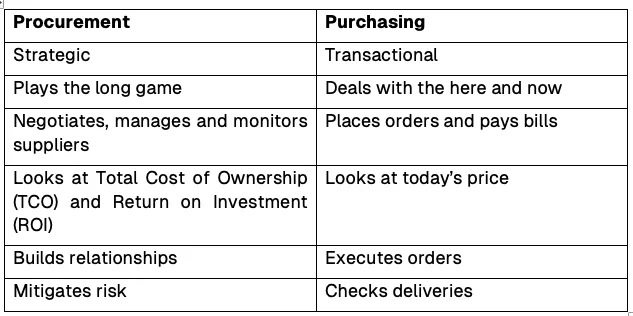
Same Need, Two Very Different Results
Scenario: You need 50 laptops for a new project team.
Purchasing approach: Call your usual supplier, get a quote, raise a PO, check the delivery, and process the invoice. Job done.Procurement approach: Check with IT about future hardware needs, compare suppliers, negotiate service terms and extended warranties, and secure a contract that saves money on the next five orders.Both get laptops. Procurement gets laptops and sets you up for future savings, better service and stronger supplier commitment.
Where They Work Together
When procurement does the groundwork, purchasing is faster and easier.
Preferred supplier lists mean no time wasted shopping around.Pre-negotiated deals make every buy cost-effective.Standardised processes cut down errors and delays.Supplier performance issues get spotted early.Procurement paves the road. Purchasing drives the car.
Beyond the Basics – Procurement’s Wider Role
In small businesses or startups, purchasing and procurement often happen in the same team — or even by the same person. But as organisations grow, strategic procurement becomes critical.
Risk Management
Procurement looks beyond price and lead times. It considers more than cost – like whether your supplier will still be in business next year. That includes:
Supplier financial stabilityEthical and social sourcing and sustainabilityGeopolitical disruptionsCybersecurity vulnerabilitiesExample: During COVID-19, companies that relied only on purchasing were left scrambling when suppliers shut down. Procurement-led businesses had backup suppliers, alternative sourcing plans, and flexible contracts in place.
Procurement folks are the ones checking the weather forecast before you hang out the washing – and making sure you’ve got a spare clothesline, just in case.
Supplier Relationships
Procurement treats suppliers as partners, not just vendors. That means:
Performance reviews and joint problem-solvingCo-developing services, products or packaging that reduce costs and wasteCollaborating on innovationA purchasing team might reorder from the same supplier every month. Procurement will work with that supplier to streamline delivery schedules, saving both time and money.
Compliance and Governance
Procurement ensures purchases align with legal, ethical, social, and regulatory standards.
In industries such as government, healthcare, or finance, this isn’t optional; it’s survival.
Example: Public sector procurement often requires open tenders, formal evaluation criteria, and documented justifications – a far cry from “just placing an order.”
When You Need Procurement vs Purchasing
Small, straightforward buys? Purchasing is the way to go.
But if you’re:
Spending big with multiple suppliersManaging inventory or project-based workConcerned about supply chain disruptionsLooking to cut costs or improve value without cutting qualityBound by regulatory or compliance obligations… then procurement moves from “nice-to-have” to “non-negotiable.”
Technology – Where the Lines Blur
Modern Procure-to-Pay (P2P) systems bring procurement and purchasing together. These tools automate the transactional work and support strategic tasks like:
Supplier onboarding and vettingElectronic sourcing (eRFx, eTender)Contract lifecycle managementReal-time spend analytics and visibilityThey’re game-changers for scaling without losing control.
Common Misconceptions
“Procurement is just a fancy word for purchasing.”
Nope. Procurement includes purchasing, but it’s broader – like saying HR is just payroll.
“We don’t need procurement – we just need to save money.”
Procurement is how you save money — sustainably and strategically. A quick bargain that costs more in repairs or delays isn’t saving.
“Our people can just buy what they need.”
Without procurement oversight, you get maverick spending, duplication, and missed chances to negotiate better deals.
Mini-Scenario: Promotional Merchandise
Need: Branded notebooks, pens, and bags for a product launch.
Purchasing-only: Marketing finds a supplier online, sends a PO, waits for delivery, then pays the invoice.Procurement-led: Works with Marketing on specs and timeline, gets multiple quotes, negotiates price breaks, checks ethical and social sourcing, and secures a deal for future events.Same products. Completely different value.
Cybersecurity – The Overlooked Risk
Both procurement and purchasing handle sensitive data: bank details, internal costings, contract terms, and supplier pricing.
Top risks:
Weak supplier IT systemsFake payment requestsContracts without cyber clausesQuick wins:
Vet suppliers’ cyber practices before signingUse secure payment channels onlyAdd breach notification and responsibility clauses to contractsTrain teams to spot phisingQuick Wins to Strengthen Both Functions
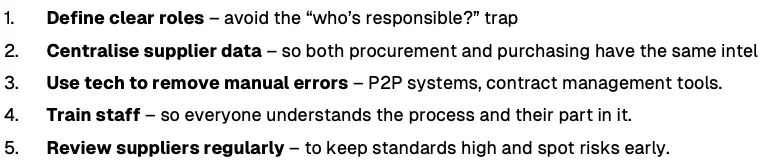
Looking Ahead
Tech, ethics and risk are reshaping both roles:
AI to predict demand and flag risks.E-procurement platforms to kill admin bottlenecks.Data analytics to uncover patterns in spending and supplier performance.Sustainability, ethical and social sourcing as standard, not optional.The future belongs to businesses that blend procurement’s strategy with purchasing’s speed.
Bottom Line
Purchasing = doing the transaction right.
Procurement = making sure it’s the right transaction in the first place.
When you get them working together, you spend smarter, reduce risk, and make your supply chain stronger.
That’s not just good procurement – that’s good business.
Share post
Need Expert Help?
If you’re recognizing these signs in your business, you’re not alone. Most growing businesses hit this inflection point.
Our procurement specialists help medium-sized businesses transition from reactive purchasing to strategic procurement without the complexity of enterprise solutions.



-

How to Implement Strategic Sourcing in Your Organisation
Understanding strategic sourcing is step one. Step two is convincing your organisation to stop buying things through a combination of urgency, habit, and “email three suppliers and hope.” That part is usually harder. The reality is that most organisations do not fail at strategic sourcing because they lack intelligence. They fail because the process becomes too theoretical, too complicated, or too disconnected from operational reality. Good strategic sourcing is not about building the world’s most sophisticated procurement methodology. It is about making better commercial decisions, consistently, across the categories that matter most. This is what practical implementation actually looks like.
-

Tail Spend | Killing Budgets by Stealth
Procurement teams spend most of their time on strategic categories, the big suppliers, major contracts, and negotiations that actually move the needle. And rightly so. That’s where the leverage is. But sitting underneath all that is a different kind of problem: thousands of small purchases, spread across hundreds of suppliers, that never get the same attention. That’s tail spend. And unlike maverick spend—where people go rogue and buy off-contract—tail spend happens entirely within the rules. It’s just never actively managed.
-
What is Strategic Sourcing and Why It’s More Than Just “Buying Cheaper”
If procurement is “getting stuff bought,” strategic sourcing is “deciding the smartest way to buy it, from whom, and why.”